
"When a measure becomes a target, it ceases to be a good measure." — Goodhart's Law
Charles Goodhart is an economist, but his principle can be applied to cultural institutions. The moment a museum decides that it needs to increase engagement or diversify its audience, it's already begun compromising the very metrics it hopes to improve.
When you optimize for a metric, you inevitably distort it and undermine your purpose in the long run. In museums, this distortion manifests as programming or content that chases demographic targets rather than addressing the underlying reasons people might find value in cultural experiences.
Goodhart's Law may make museum professionals with "engagement" in their titles uncomfortable. It's a pithy condemnation of everything that museums have worked toward in the 21st century. As museums have proudly transitioned "from being about something to for someone" (Stephen Weil), I imagine few are eager to hear that the work has just begun — that being "for someone" is so much more complex than being for different demographics. But is anyone going to argue that a person can or should be reduced to how the state describes them on a census form?
Goodhart's Law reminds us that mirroring demographic ratios in museum content is not an end in itself because ratios have little relationship to a museum's ability to fulfill a role in a city or region.
What counts isn't who people are on paper, but what progress they're trying to make in their lives. Demographics might tell you something about who is in your space, but they reveal nothing about why they came or what they hoped to achieve.
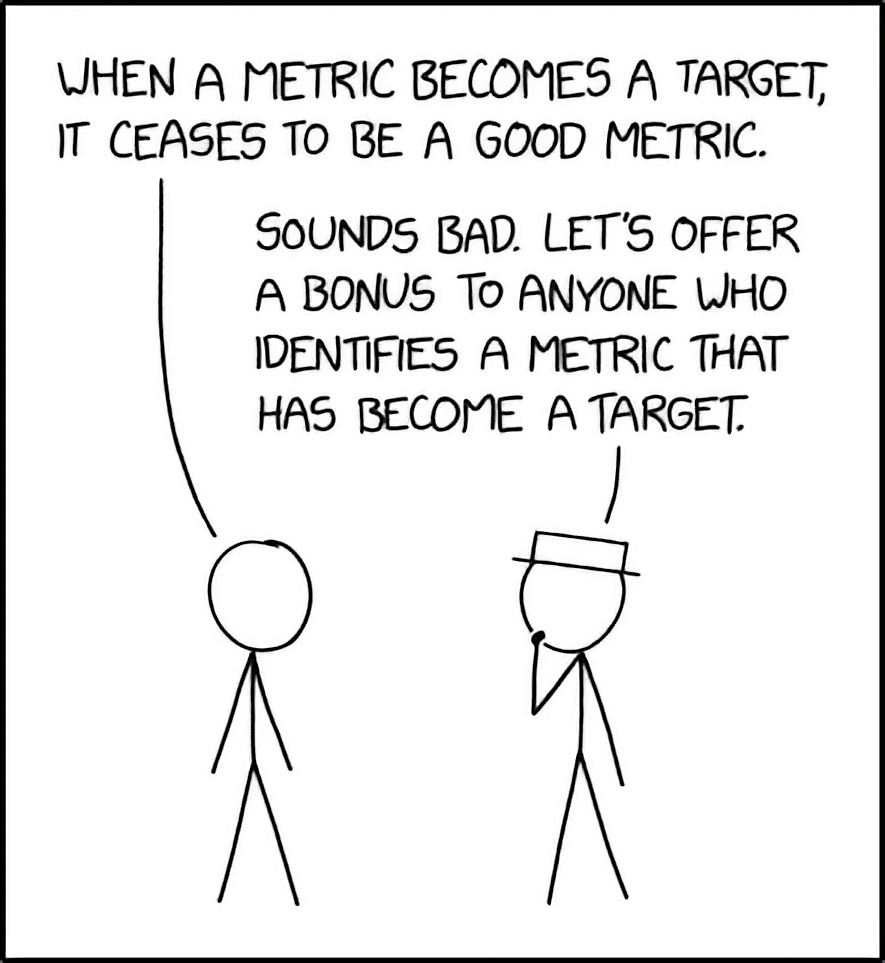
Image via xkcd
Isn't “Progress” Just Another Target?
You might be thinking, "If we trade engagement metrics for progress metrics, aren't we just creating a new version of Goodhart's Law? Won't 'progress' become our next distorted target?"
While any measure can, in theory, become corrupted when treated as a target, progress metrics have a few advantages: First, they resist standardization. Supporting a community goal like "helping parents cultivate their child's curiosity" requires understanding the diverse approaches people take in pursuing that goal and the alternatives people in a particular place might turn to as they seek to achieve their goal. You can't reduce it to a single number. Second, progress metrics require ongoing listening rather than predetermined solutions. When you focus on supporting goals, you have to constantly validate whether your approaches are working, creating a natural correction mechanism.
Progress may not be immune to Goodhart's Law, but its inherent complexity creates friction against the simplification that leads to metric distortion. Unlike engagement, progress forces us to always keep "dancing with systems" — to take on a continuous, adaptive approach to understanding and supporting what truly matters.
A museum that supports genuine progress becomes genuinely relevant — not because it "engaged" a target demographic, but because it creates meaningful value in people's lives, which is a measure worth pursuing.