
Robert Janes named the challenge in our recent Strategy Circle with California Academy of Sciences when he pointed out that "The era of big solutions is over."
Janes was acknowledging a stark reality: Federal funding evaporates. Support dwindles. Cultural institutions face existential questions. We can blame oligarchs and short-sighted capitalists, but that's like complaining about gravity after falling out of a plane.
The problem is that most museums treat engagement as the last lap around the track when it's more like the starting line.
Stuck in the Middle
In her book, Engaged: Designing for Behavior Change, Amy Bucher shows a high-level outcomes logic map (p. 21) that describes the data that should be available over the lifespan of a product to understand whether it will achieve its intended results. It looks like this:
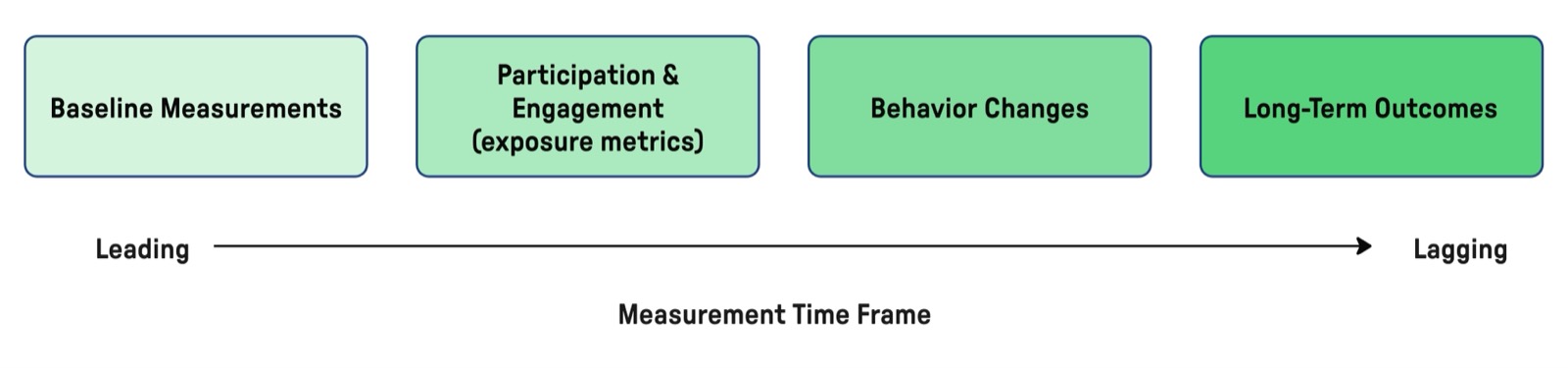
Most museums are focused entirely on step two, which is kind of understandable — After all, if you haven't identified what kind of change you're aiming for, what else can you measure? Participation. Bodies through doors. Satisfaction scores. These metrics are the beginning and end of the story museums can tell about the value they provide; Fewer and fewer people are convinced we need that story, and that, too, is understandable. Tracking participation alone is like celebrating that someone opened a cookbook without checking if they ever cooked a meal or how the meal they made affected their health. Cookbook nerds will struggle to understand to why the results matter, but to most other people (including those who buy cookbooks!) it’s obvious why you’d be interested in results.
Museums can satisfy more than the needs of the few — they can be products designed to change behavior. A science center could alter resource consumption patterns (visitors use less water; members plant native gardens). A history museum could increase civic participation (people vote more). A children's museum could improve academic outcomes through play-based learning.
But we don’t often name these intended changes. We've convinced ourselves that engagement itself is enough because we're museum lovers surrounded by museum lovers, unable to imagine museums needing to do anything more — indeed, the notion that museums should do more can feel like a threat to our identity.
The Missing Mechanism
Returning to Bucher’s book, "mechanisms of action" are bridges between experience and outcome — they facilitate the desired outcomes in your logic map (Bucher, p. 21).
A natural history museum provides take-home toolkits, creates follow-up challenges, connects visitors to local environmental groups, sends progress tracking emails, celebrates small wins. It builds loops that reinforce new behaviors.
A history museum registers voters on-site, partners with local government, creates civic action challenges, follows up with participants, tracks actual voting patterns.
A children's museum teaches parents observation techniques, provides developmental milestone guides, creates home activity extensions, measures actual school readiness improvements.
Without mechanisms that produce outcomes, an outsider might say that a museum is just an costly entertainment venue.
None of this is easy, and — like museums — we're still trying to figure out this transition from output to outcomes. MaP³, for example, is how we're establishing the baseline in Stage One of the logic map above. Through programs like The Value Realization Collaborative and The Community Goals Study, we're learning alongside our partners what those "mechanisms of action" actually look like in practice — it’s both harder and more promising than I had imagined.
Questions Worth Asking
Your museum might have impressive satisfaction or engagement results. Consider these questions instead:
What specific behaviors might change after people leave? Not what you hope changes. What actually changes. And how would you know?
What mechanisms could support those changes? Not elaborate systems. Simple bridges between experience and action.
How might you track progress over time? Not perfect data. Just better data than yesterday.
What if the real question isn't whether people enjoyed their visit but whether their visit resulted in behavior change that they enjoyed?