
The conventional wisdom says museums need to fix internal challenges before engaging external communities. But what if this thinking creates a false choice that prevents progress on both fronts?
Beyond the Either/Or Mindset
The question of institutional readiness looms large in conversations with museum leaders. There's an implicit assumption that prioritization requires trade-offs — that institutions must follow a proper sequence or developmental arc.
"We need to get our house in order before engaging external communities" appeals to a "put on your oxygen mask first" wisdom that's hard to refute. But museums aren't helpless passengers in an emergency. In practice, this rigid sequencing may become cover for indecision or perpetuate a excessively-long preparation mode, spending so much time packing for a journey that they never leave the house. For the Civil War enthusiasts reading this, think McClellan vs. Grant — one general endlessly organizing and training but rarely engaging, versus another who understood that engagement itself was often the best path to improvement.
Reviewing a discussion from last year, I realize I accepted the underlying framing of "this before that" without question:
… Without some predetermined criteria for success, it seems like internal improvement efforts could go on indefinitely. I don’t think there’s some universal formula — every museum has to decide for itself the threshold for success — but shouldn’t there be at least some menu of characteristics or milestones that museums can use to have that discussion?
Maybe there is some basic criteria needed for a museum to focus on participant outcomes and community goals, but a year later I wonder if whatever internal challenges a museum faces may be better addressed through the shared purpose of focusing on service to an outside group. Of course, to do that, a museum has to decide on a specific outcome or community goal it wants to support, which is much more difficult and scary than pursuing "Our 14 Strategic Pillars and 96 Metrics of Success" that typically dilute museum impact, contribute to a lack of cohesion, and provide unlimited cover for evasion.
Integrative Thinking: Rejecting False Trade-Offs
In his book, The Opposable Mind, Roger Martin calls this "integrative thinking". Rather than accept the options before us and the trade-offs that accompany those choices, we can create solutions that incorporate the strengths of multiple approaches. This aligns with Richard Rumelt's view of strategy as a fundamentally creative act.
You might be thinking, "But this is exactly what 'The 14 Strategic Pillars and 96 Metrics of Success' does. We've accumulated a host of different approaches and diverse perspectives and developed a strategic plan that addresses them all."
Channeling Martin and Rumelt, I'd say that accounting for multiple approaches isn't the same thing as choosing the approaches that return compounding benefits in service of a singular objective. In the rush to solve or produce, we mistake accumulation for integration.
Integrative thinking challenges the belief that we must choose between addressing internal alignment OR external engagement. Instead, it creates pathways where community-focused work becomes the catalyst for internal transformation. Think of it as learning to swim by actually getting in the water, not by forever studying swimming techniques on dry land.
The Assessment Landscape: Testing Our Hypothesis
To find out whether an integrative approach that accepts external focus as a solution to internal challenges works, we need empirical evidence. This month, I've been reviewing our first batch of MaP³ assessments. The MaP³ assessment measures strategic alignment, participant outcomes, learning capabilities, and financial performance and is the first step for institutions enrolling their staff in our community of practice.
The museum sector has developed several assessment frameworks, each reflecting different underlying assumptions about what matters:
AAM's Museum Assessment Program provides established benchmarks and peer validation. Its strength lies in answering "Are we aligned with field standards?" — valuable for accreditation preparation and operational excellence. Its limitation is that standardization naturally prioritizes established practices over disruptive approaches, potentially reinforcing existing patterns rather than challenging them. AAM's assessment may be best for museums that are confident that museums are generally on the right track and simply need to improve along familiar lines.
MASS Action's Readiness Assessment centers equity principles and power dynamics through self-guided evaluation. This approach is particularly valuable for institutions examining structural barriers. MASS Action's assessment may also be representative of a host of other do-it-yourself assessments that can be found online. These DIY and open-source approaches offer accessible (free) entry points, though I'm not sure how much change can come from worksheets alone. In fact, it's possible that free self-assessments and toolkits, while valuable for some, may nibble away at staff energy reserves — death by a thousand half-implemented paper cuts.
OF/BY/FOR ALL's Change Network program was perhaps the closest relative to MaP³ — Their assessment was complimented by a strong community component, and I'm still sad that they closed their doors last year. Still, like all programs and including ours, OF/BY/FOR ALL operated under certain critical assumptions that colored all subsequent results — in their case, a fundamental belief that community partnerships that were built on demographic-first definitions was the best approach to achieving DEI objectives and that cultural institutions could solve the relevance riddle by reflecting demographic diversity in their content and experiences. We can debate the merits of those foundational beliefs, but they serve as another example of how all these kinds of organizations and efforts are built on core assumptions and, indeed, a specific point of view on fundamental questions is probably necessary for any effort like this.
Through our MaP³ assessments and Value Realization Collaborative, we're testing a different hypothesis: focusing on specific community outcomes might actually accelerate internal alignment rather than impede it, providing better results across the four dimensions we identify as being critical. While it's too early to make definitive claims, the initial patterns we're observing with participating institutions are promising.
The point isn't that one approach is superior — it's that each framework reveals different aspects of institutional reality. It's important to choose the program that best aligns with your objectives and whose underlying assumptions you find worth your time and resources.
Four Dimensions That Reveal Your Strategic Path
Our MaP³ assessment examines your institution through four interconnected lenses:
1. Strategic Alignment
Do staff have a shared understanding of the critical challenge? Our analysis doesn't just measure alignment — our purpose is to identify whether community focus might actually create the alignment you're missing. For some institutions, a shared external purpose can become the rallying point that resolves internal fragmentation.
2. Participant Outcomes
What inherent strengths can provide your unique advantage? Every institution excels at creating specific visitor outcomes — whether fostering conversation (social well-being), enabling discovery (intellectual well-being), or providing transformative experiences (personal well-being).
When staff recognize these shared strengths across departmental boundaries, they discover common ground that transcends internal divides.
3. Learning Capabilities
Where can knowledge flow be improved to realize better outcomes? Sometimes the greatest barrier to internal progress is the absence of shared external purpose. We identify learning deserts within the organization — departments that may be unaware of insights being gathered in, for example, visitor experience — and then use our community of practice as a platform to cultivate a shared understanding of what knowledge is being created and why it matters.
4. Financial Performance
How will strategic direction impact resource sustainability? This is where we hold ourselves accountable. We don't believe that institutions should be profit-driven, but we do need to ensure that focusing on outcomes is contributing to the bottom line.
And then what?
We can't just measure and run. This, in my opinion, is one of the critical shortcomings of assessments like AAM's, which may satisfy a desire to understand performance but then offer little creative guidance around what to do next. This is where community can help. MaP³ assessments produce an in-depth portraits of institutions that let us take our community to the next level by creating tailored discussions like this that bring together organizations facing similar challenges.
For example, we've found that a number of academic museums in our community share a similar challenge: How do we serve both our university population and local communities? We can respond by hosting conversations like this one that foster learning across different institutions.
Moving Forward: A Both/And Proposition
The question isn't whether your museum should prioritize internal improvement or community engagement. The question is: How might focusing on participant outcomes and community goals actually accelerate your internal transformation?
If this is a question that's important to your institution — or if you're hoping to get a view of how your museum is performing across the four areas we're prioritizing — you can learn more about MaP³ here. Here's a view of what can emerge as we look at these various dimensions of organizational performance — in this case, area #1 Strategic Alignment:
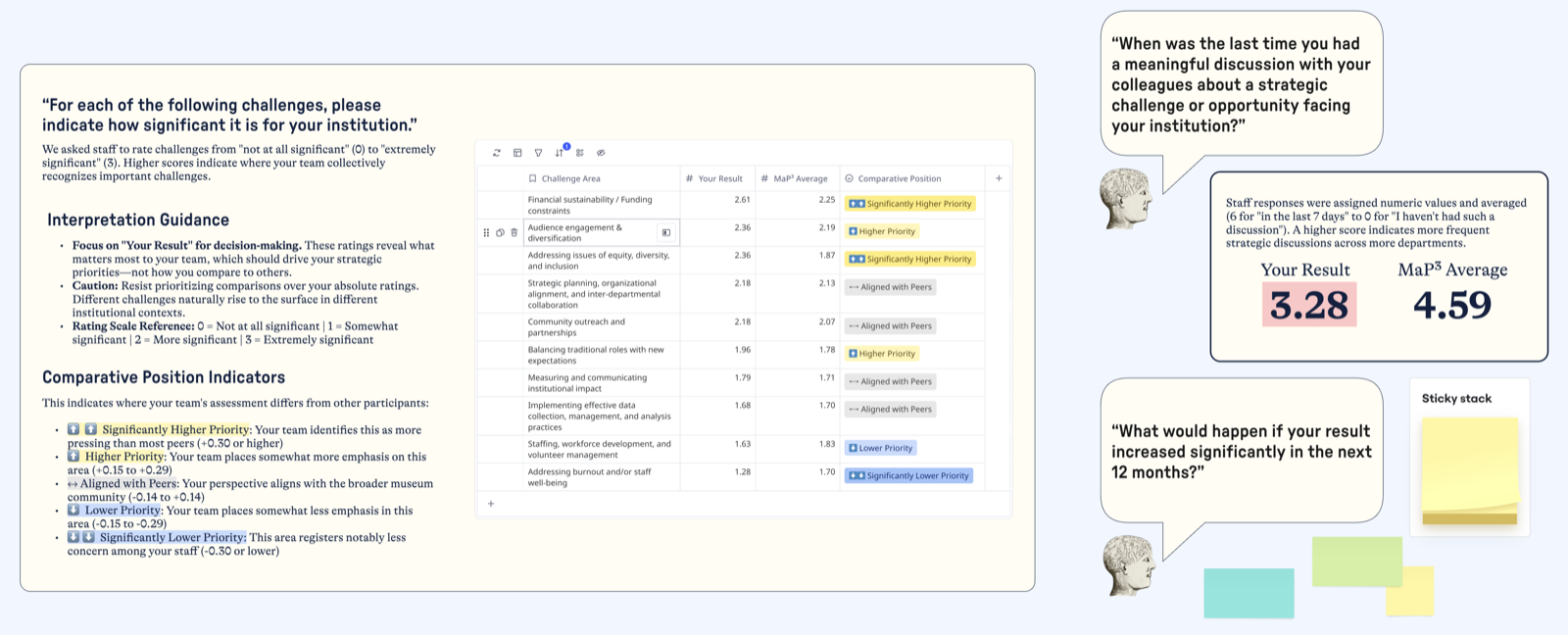
Click here to enlarge and interact with the example above.
This snapshot reveals how one institution's strategic priorities compared to peer organizations — note the "Significantly Higher Priority" markers showing where this museum's team collectively placed greater emphasis than their peers. By identifying a critical challenge, this creates a valuable lens through which we can prioritize which participant outcome (area #2 in our assessment) will have the greatest impact on the institution's objectives.
The most powerful strategic plans don't try to do everything at once. They create focus through a single, unifying purpose that aligns teams and resources. For museums seeking both internal coherence and external relevance, we think community goals offer exactly this kind of rallying point.
When we let go of the false choice between fixing our internal house and engaging our external communities, we discover that these aren't competing priorities but complementary forces. The real transformation happens when we view participant outcomes not as a distraction from operational excellence but as the very catalyst that makes it possible.
Have a great week,
Kyle
Note: MaP³ pricing will increase on April 1st. Institutions that begin the assessment process before this date will be grandfathered at current rates.