
Studies consistently show that about 80% of drivers rate themselves as "above average" behind the wheel. This statistical impossibility reveals a common human bias — we tend to overestimate our capabilities in areas we practice regularly. Cultural organizations can face similar blind spots when it comes to listening to their communities.
Museums run surveys, hold focus groups, and gather visitor feedback. These traditional methods often reinforce institutional assumptions rather than revealing what communities actually need. The problem isn't a lack of data — it's asking the wrong questions entirely.
A fundamental shift is reshaping the cultural sector. Changes in technology, visitor behavior, and audience demographics are converging, creating both urgency and opportunity. As museums pivot toward more community-centric approaches, their ability to truly listen has never been more critical.
For decades, museums have relied on traditional research approaches to understand member, visitor, and non-visitor motivations. While these methods have shaped strategic planning in the past, their limitations are becoming clear in today's competitive landscape. The gap between what museums measure and what actually drives audience decisions continues to widen.
Why Traditional Research Fall Short
A key problem with traditional research methods—both market and audience research—is their inability to address the deeper motivations behind people’s decision-making processes. Asking members how satisfied they are with their membership or if they enjoyed their last visit often yields superficial answers that fail to capture the true drivers of their behavior. Similarly, traditional market research results in incomplete data due to its inability to capture the complexity of individual needs.
Research shows that most decisions are rooted in complex emotional factors which respondents may not be able to fully articulate, even if they wanted to. In a world where reliable data is a necessity, museums must go beyond the superficial findings produced by traditional research to uncover the deeper motivations driving audience behaviors.
While there is immense value in quantitative research, numbers alone rarely tell the full story. A spike in attendance or membership might indicate success, but without context, it’s impossible to know what drove the increase or its broader implications.
Breaking Down the Listening Problem: Five Common Pitfalls
The Satisfaction Trap: Museums often focus on satisfaction scores with existing offerings. While useful for optimization, this approach misses opportunities to support entirely different community goals. A museum might achieve high satisfaction ratings while remaining irrelevant to large segments of their community.
Demographics Default: Many museums begin their audience diversification efforts by examining demographic data. This reinforces surface-level thinking about who people are rather than understanding what they're trying to accomplish. Demographics might describe populations, but they reveal nothing about motivations or goals.
Expert Bias: Museums tend to design research questions from their position of expertise. This creates blind spots around how non-experts approach cultural experiences. The result is research that confirms institutional assumptions rather than revealing new insights.
Activity Focus: Much museum research emphasizes what people do in museums rather than why they do it. This leads to improving existing activities instead of understanding whether those activities actually support community goals.
Quantitative Comfort Zone: Many museums gravitate toward quantitative metrics because these numbers feel more objective and are easier to report to stakeholders. But numbers without context can mislead. Rising attendance, for instance, tells us nothing about whether we're actually supporting community goals.
To bridge this gap, museums must adopt a mixed methods approach that combines the precision of quantitative data with the richness of qualitative insights. Further, cultural organizations should prioritize research approaches that offer insight into the hidden motivations that build emotional connection. These types of unspoken emotional needs are the strongest drivers of customer value and the real reason why people remain loyal to an organization.
The Case for Mixed Methods
A mixed methods approach integrates quantitative data (the “what”) with qualitative data (the “why”). This combination provides a more holistic understanding of audience needs, enabling cultural organizations to design more effective strategies and deliver greater value.
The value of qualitative research is that it captures the stories and emotions behind the numbers. Through techniques such as interviews, voice surveys, and observational studies, museums can uncover the motivations, frustrations, and aspirations that shape audience behavior. By revealing the texture of the human experience, qualitative methods offer insights that numbers alone simply cannot deliver.
Combining the power of quantitative data with the richness of qualitative insights, museums can unlock a deeper understanding of not just what people do, but why. Moreover, integrating quantitative and qualitative methods is a more inclusive approach as it accommodates diverse needs and abilities such as individuals who may struggle with typing, visual impairment, or literacy. This blended approach to listening allows museums to make decisions that are both data-informed and empathic, leading to more impactful outcomes.
Beyond Surveys: The Future of Research
Traditional surveys tend to be narrow even when they appear exploratory. Consider how many museums approach community research: "What programs would you like to see?" "How can we improve your museum experience?" "What would make you visit more often?" These questions feel open-ended but share a critical flaw—they assume the solution must involve a museum. Truly exploratory research starts with understanding people's goals, not prescribing solutions. Instead of asking "What do you want from us?" we might ask "What progress are you trying to make in your life?" This shift reveals how traditional surveys, even those with open-ended questions, can inadvertently constrain our thinking and limit our understanding of what's possible.
Think of it like a doctor who hands you a menu of treatments before understanding your symptoms. The menu might be extensive and even include a write-in option, but it's still working backward from solutions rather than forward from needs. When we frame questions around what museums can offer rather than what people are trying to accomplish, we miss opportunities to support genuine community progress.
To overcome the limitations of traditional surveys, museums must prioritize a mix of research methods, including:
Voice Surveys and Interviews: Capturing tone, inflection, sentiment, and emotion adds layers of meaning, providing a more nuanced understanding of respondent experiences. Here we are seeking quality not quantity. When paired with quantitative data, the input gained from voice surveys and interviews provides a more complete picture of audience needs.
Card Sorting: A simple yet powerful tool, card sorting exercises can help museums understand how people organize and categorize information. By allowing participants to group and label items based on their intuition, card sorting provides insight into an individual’s mental models and thought processes.
Field Experiments: When it comes to understanding human behavior, what people say and what they do often differ dramatically. Relying on self-reported data alone is risky. Field experiments offer a powerful way to measure real-world behavior by observing audience actions in authentic contexts. By testing hypotheses in a natural environment where participants are unaware that they are part of a study, field experiments allow museums to gather objective and validated data.
Observational Research: Watching how visitors interact with exhibits or how members experience programs can reveal behaviors and preferences that respondents might not consciously be able to articulate. Further, observing how current and prospective visitors interact with competitors or alternatives, can give museum leaders deeper insight into people’s unmet needs. Such insights go well beyond product improvement—informing long-term strategies, membership innovation, and service design.
Extremes: Important insights can be gleaned from talking to people who are not in the majority. In design thinking, the term “extremes” refers to individuals who fall on the edges of the bell curve. Extremes always come in pairs of either “super users” (e.g., brand fanatics, experts, and early adopters) or “non-users” (e.g., cynics, abstainers, or laggards). For example, consider the following pair of extremes: (1) a long-term visitor who has never been a member (a non-user) and (2) a member who visits every day (a super user). Extremes are people who feel a particular need most acutely or not at all. By understanding the perspectives of extremes, cultural organizations can sharpen the value proposition of existing and/or new offerings.
Predictive Analytics: Predictive analytics—the process of using data to forecast future outcomes—has emerged as a transformative opportunity for museums to reshape how they engage with their audiences. Through advanced data analysis, machine learning, artificial intelligence (AI), and statistical models, museums can identify patterns that predict future behavior. Leveraging predictive modeling for research leads to more relevant and actionable insights, enabling museum leaders to anticipate and adapt rather than simply respond to what has already happened.
Incorporating a mix of research methods delivers a more holistic and reliable view of why people make certain choices thereby positioning museums to better meet the needs of their communities.
Asking the Right Questions
It’s not just the method selection that makes for meaningful research outcomes—if you’re not asking the right questions, no adjustment in methodology is going to correct for this misstep.
One promising alternative to traditional research questions is the Jobs To Be Done (JTBD) framework, which shifts the focus from demographics and satisfaction scores to the underlying motivations behind purchase decisions. First introduced by marketing scholar Theodore Levitt, JTBD posits that people “hire” products or services to perform specific jobs. By identifying these jobs, museums can better align their offerings with what visitors and members truly want and need.
As Harvard Business School professor Clayton Christensen explains, every job has functional, social, and emotional dimensions. Understanding these dimensions enables organizations to design offerings and experiences that precisely meet audience needs. For example, instead of marketing a membership program based on transactional benefits like discounts and free parking, museums could explore the deeper motivations behind why individuals join. Are they seeking a sense of belonging? A way to interact with their community? An experience that builds connection with friends and family? By addressing these underlying needs, museums can create more meaningful and engaging experiences.
At MaP, we’re applying the JTBD framework to investigate the drivers behind member decisions, helping museums design more intentional and relevant offerings. Leveraging a mixed methods approach, The Community Goals Study blends a set of JTBD-focused survey questions with a voice survey to gain richer insights into the specific goals members are seeking to accomplish in their lives.
Importantly, this study is not designed to evaluate programs or member benefits. Instead, the goal is to explore the deep currents that move members through their lives. The distinction is critical. While most organizations ask, “How can we help people have a better experience at our museum?” they should be asking, “How can our museum support people’s goals?” Flipping the question allows us to map the landscape of human goals and aspirations and pinpoint where the museum could play a vital role in meeting audience needs.
Overcoming Marketing Myopia
Many museums suffer from marketing myopia, an overemphasis on selling their products rather than addressing what their audiences truly need. Traditional marketing efforts often focus on promoting specific content, such as new exhibitions or featured speakers, based on assumptions that these are the primary drivers of visitation. However, research suggests that audiences are less motivated by content and more by the overall experience. Visitors may be drawn to a museum for reasons that have little to do with its exhibits, such as the opportunity to create lasting memories with loved ones or to find inspiration in a peaceful environment.
Researcher John H Falk emphasizes the need for museums to be more responsive to audience motivations as well as the importance of ensuring that marketing reflects how the museum experience can meet visitors’ needs. Falk makes the case that museums will need to get measurably better at understanding and serving their audiences if they are to remain competitive in the future, and the JTBD framework is ideal for teasing out these opportunities.
Early findings from The Community Goals Study reveal a counterintuitive pattern: Members frequently participate in activities they find unsatisfying, while expressing only slightly higher levels of satisfaction for experiences they pursue on a near daily basis. This disconnect suggests cultural organizations may be overlooking their most powerful paths to impact.
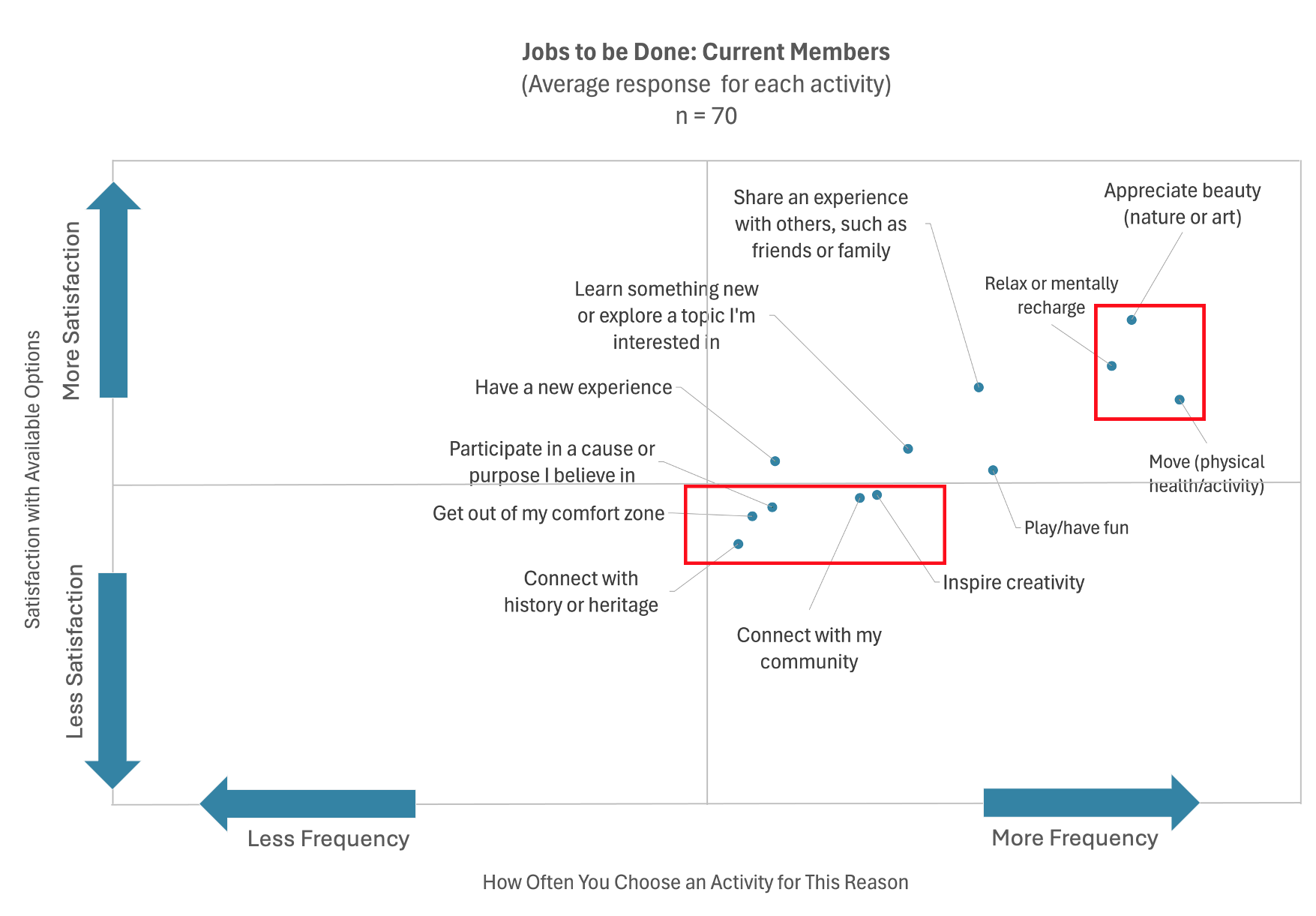
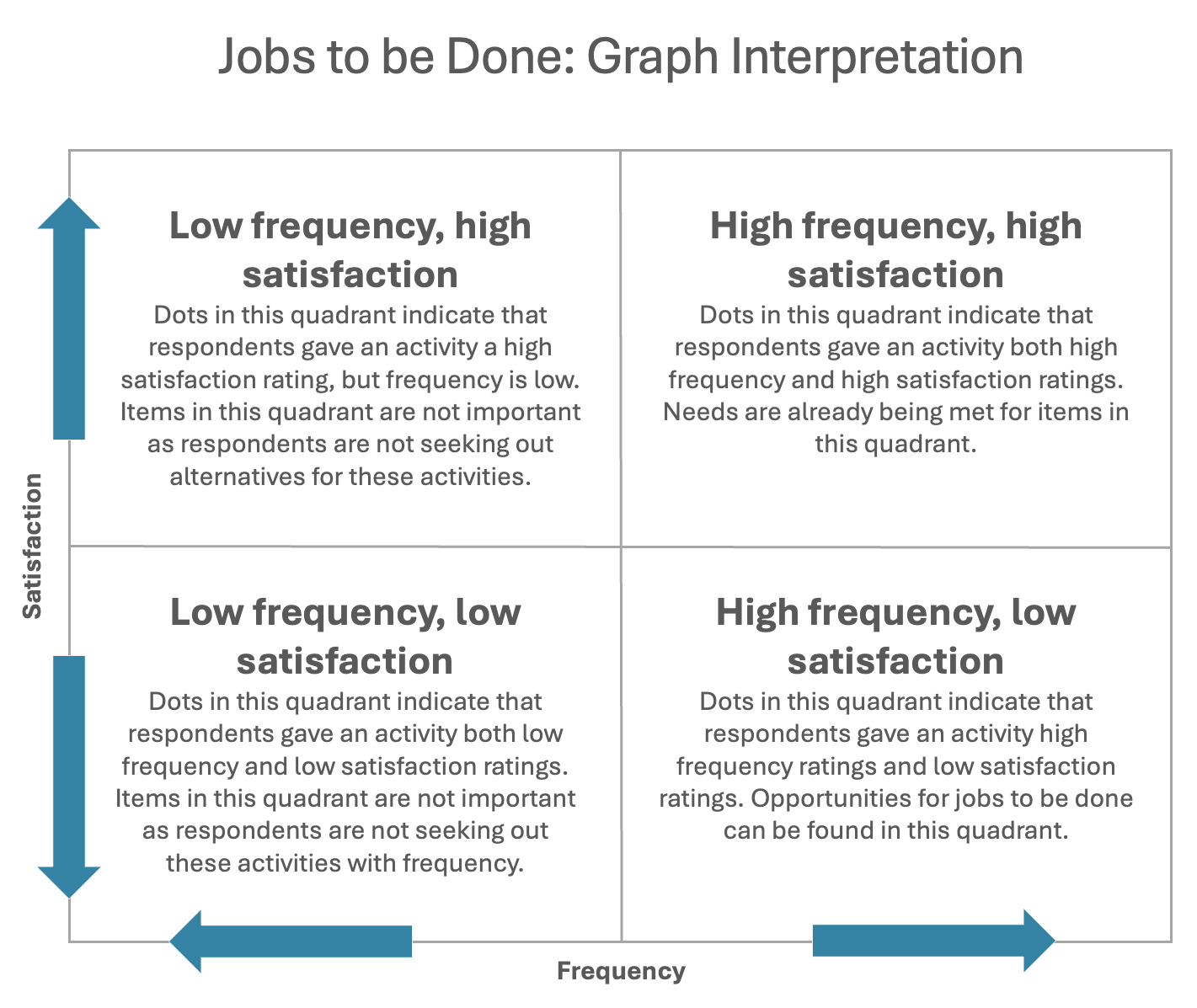
Consider the finding that members are generally less satisfied with their options for getting out of their comfort zone and connecting with their community even though interest in participating in such activities with some frequency was relatively strong. How might a museum design an experience to better meet these needs?
Initial insights from the study also indicate that members are regularly seeking out experiences that allow them to connect with history and heritage, yet they often pursue museum alternatives to meet this need. Below are two examples from members:
I'm very interested in World War II. I was in Luxembourg and I got to go to the American Cemetery. We had a speaker who brought you back to what it was like in the war. ... His passion for the people who lost their lives, even for the Americans, everyone, he was just amazing. … It was a life-changing experience for me and helped me to understand more about World War II.
Sure, so when I went to Miller Brewery in Milwaukee, there was a shared sense of passion for beer, as well as the German heritage, history, and kind of the, I suppose, the pride of what was created from immigrants.
Finally, the findings suggest an opportunity for cultural organizations to capitalize on their core strengths such as a desire to “relax or mentally recharge” or to “appreciate beauty.” By reframing their content and offerings through the lens of JTBD, museums can become more responsive to a diversity of audience needs.
Becoming a Better Listener
Internalizing the concept of JTBD and recognizing that it is the specifics of the job (or goal)and its accompanying motivations that matter most will be paramount as cultural organizations plan for the future. Museums leaders will need to rethink their approach to market and audience research to reflect this new reality if they are to be successful in attracting new audiences and retaining existing visitors, members, and donors.
To remain competitive, museums must prioritize deep, continuous listening. Doing so requires moving beyond traditional research methods and questions to explore the personal stories, experiences, and underlying motivations that drive visitation and membership adoption.
Transitioning to a community-centric approach is no small feat, particularly for organizations steeped in tradition. However, museum leaders can take incremental steps to drive meaningful change:
Adopt an Experimental Mindset: Museums should embrace a culture of experimentation, continuously testing and refining new ideas. This approach allows organizations to respond quickly to changing audience needs and preferences.
Leverage the JTBD Framework: By identifying the jobs visitors and members are hiring the museum to do, leaders can design offerings that more effectively meet a diversity of audience needs and motivations.
Invest in Qualitative Research: Qualitative methods that capture personal stories and emotional motivations can provide deeper insights into audience behavior. Museums should prioritize adding qualitative and semi-qualitative approaches to quantitative audience and market research.
Rethink Marketing Strategies: Museums should focus on promoting the broader jobs of the museum experience, such as fostering connection or providing inspiration, rather than narrowly emphasizing specific content or transactional membership benefits.
Engage Audiences in Co-Creation: Involving visitors and members in the development of program, exhibit, and membership design can provide valuable insights while cultivating a sense of ownership and connection.
Implement a Practice of Continuous Listening: Research should not be viewed as a single, time-bound project that happens only once every year or two or whenever there is an upcoming strategic planning session. Instead, museums must implement a practice of continuous listening by providing audiences with an opportunity for ongoing feedback. Such an approach might include weekly or monthly interviews with visitors and/or a running survey with members that includes a semi-qualitative component.
As museums navigate an increasingly uncertain and competitive marketplace, transitioning to a community-centric approach is no longer optional—it is essential. By rethinking traditional research methods, embracing exploratory frameworks like JTBD, and prioritizing audience needs over institutional priorities, museums can position themselves for long-term success.
While the path forward may be challenging, the rewards—more engaged audiences, greater financial stability, and a renewed sense of purpose—are well worth the effort.
Interested in exploring community goals at your organization?
Registration is open now for the Winter/Spring Season of The Community Goals Study. The deadline to enroll is March 31, 2025.