
When resources are scarce, helpful mental models become increasingly valuable. Museum leaders1 need frameworks for evaluating questions as much as they need answers to those questions. It’s arguably just as valuable to have a way to assess when it’s worth it to generate new information, for example, as it is to have ways of generating new information.
Models can seem like abstract, semi-useless things until you encounter a moment when they can help you make sense of your lived experience.
I had one such experience in last week’s webinar (replay) when several people asked a question that I’ll summarize by using a particular instance of it from the chat transcript:
Can the presenters provide specific examples about how they’ve accomplished their outcomes?2
The question stuck with me because, in a sense, the entire session was an example of how two people and their organizations have gone about accomplishing this work of focusing on participant (visitor) outcomes. I wondered, “How can we get more specific than to have two museum leaders present what they’ve done, the challenges they’ve encountered, and how they’re working to overcome those challenges? We even had photos of them doing the work at their museums*.* Why would people ask for examples when they’re looking at and listening to examples?”
But just because something feels obvious to me doesn’t mean that the problem isn’t real or isn’t worth attention. If people in that session came away with a question like that, it’s worth probing for potential blind spots.
Enter the Knowledge Funnel
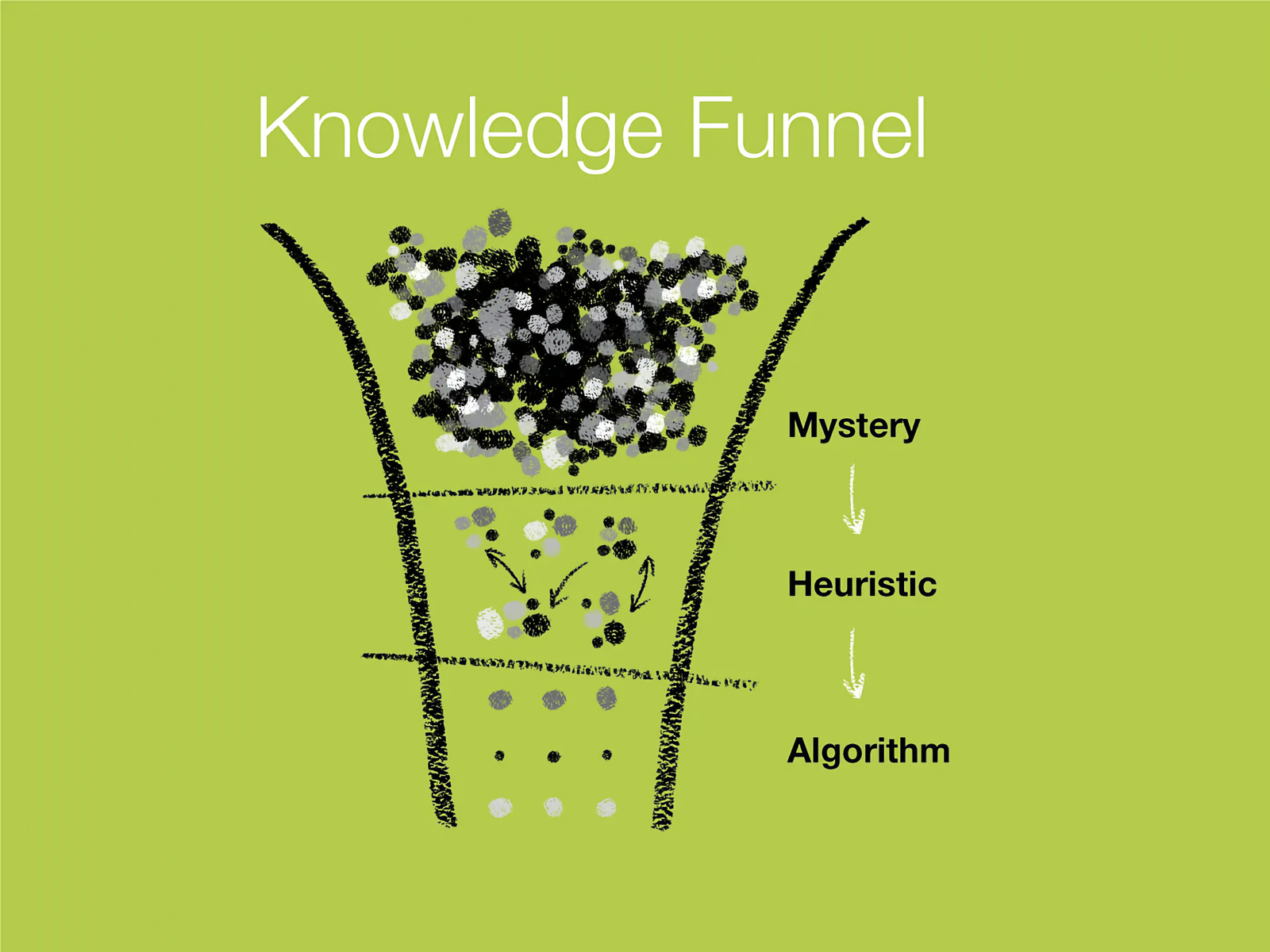
When people ask for examples they’re already seeing, they’re often really asking: “What’s the formula?” That impulse — the desire for a reliable algorithm — reveals where we are in understanding this work. Behind the question lies a deeper question about the kind of problem we’re dealing with, which can be explained through Roger Martin’s knowledge funnel model.
Source: Roger L. Martin, 2023
Learning (or ‘research’) is valuable to organizations to the extent that it reduces uncertainty and risk. It may be self-evident, but still worth remembering that the goal of learning is to produce better outcomes for individuals and organizations3. The knowledge funnel is useful here because it describes how uncertainty is reduced over time — understanding where we are in the funnel with any given question is a way to gauge how much effort may be required to arrive at a satisfactory answer, whether a satisfactory answer is even possible, and how much we can reasonably expect to glean from, for example, a one-hour webinar on using well-being outcomes as a guiding principle in organizational strategy.
Naming the parts of the model:
A mystery is a complex challenge or area of great uncertainty. To use one of Martin’s examples, why things fall to the earth was a mystery for most of human history. People in different places at different times came up with various explanations across cultures — Aristotelian natural motion held that objects sought their “natural place” in an ordered cosmos, for instance. Other cultures explained what we now call Gravity in animistic terms.
A heuristic is a rule of thumb or approach that helps progress toward a solution but doesn’t guarantee the desired answer. It’s quite valuable because it narrows the field of relevant features to consider. Kepler’s laws of planetary motion were heuristics — observations about how celestial bodies move that proved useful for prediction, though they didn’t fully explain why they moved that way.
Finally, an algorithm is a reliable formula that consistently produces the desired answer — precise enough to be standardized and automated. Newton’s law of universal gravitation (F = G(m₁m₂)/r²) represents this stage: a formula precise enough that anyone can calculate the gravitational force between two masses and get the same reliable answer.
The mystery of belonging
To bring this back to museums, an example of a mystery would be the question: How can we ensure people feel welcome at our institution? Sometimes this question is expressed along the lines of How can we cultivate a sense of belonging among x group?
In both cases, the people asking are usually thinking about some demographic — people of a certain age, ethnicity, income, or educational level.
We see a variety of answers performed by different institutions. Some apply various co-creation efforts, others host different kinds of listening initiatives, and still others audit their collections (or what’s on view/accessible) to achieve some proportional representation of various groups.
Such diverse activities, coupled with a question that won’t go away, are evidence that the sector is wrestling with a Mystery. If we had actual heuristics, we’d see more convergence — approaches that reliably narrow the field of relevant features and reduce the variety of solutions institutions are trying. Instead, we see divergence and a question that persists despite years of effort. That pattern suggests we may be performing rituals rather than solving the underlying problem.
There’s still much room for fundamental questions when it comes to this question of helping people feel welcome or connected. For example, is it even correct to assume that people define themselves in the same way the museum does? Has anyone stopped to find out if the people we want to welcome into the museum actually think of themselves primarily in terms of their income, educational level, or ethnicity? Demographic factors can create real barriers to access and comfort — but that doesn't mean demographic identity is central to how people understand themselves or what they're seeking from a museum visit. If we're solving for the wrong framing of the problem, that means all these efforts may be the museum equivalent of explaining gravity through Aristotelian natural motion or animism.
That’s not to say the Mystery isn’t worth addressing — only that the supposed heuristics we’ve developed may be operating on incorrect assumptions. Some institutions may believe they’ve got the answer — that is, they have a satisfactory answer that works for them (which may just mean, ‘we’ve performed the necessary rituals to finally get staff to stop asking about this pesky belonging question’). But given the persistence of the question, their solution hasn’t produced a theory that spreads and helps other museums reduce the variety of approaches to addressing the question.
From Mystery to Heuristic
Apply this to the webinar question: Can the presenters provide specific examples about how they’ve accomplished their outcomes?
If we look at the question through the lens of the knowledge funnel, more questions emerge:
What kind of problem were we examining in the session? The underlying premise was that a focus on visitor outcomes (even over traditional museum expertise) will produce better results for the people the museum supports and the museum itself.
Do we have an algorithm museums can use to apply an outcomes-centered approach in their various contexts? No. Safe to say we are far from having any sort of plug-it-in-anywhere-and-it-will-work playbook for this kind of work. And it’s an open question whether any such algorithm would be feasible or desirable.
Do we have heuristics museums can use to apply the approach? We're getting there. The Baseline Assessmentrepresents an emerging heuristic — a structured approach for introducing outcomes thinking that narrows the field of relevant features (participant experience over institutional priorities alone, measurement of what matters over what's measurable, outcomes over outputs). It doesn't guarantee success, but we’re seeing it help museums progress toward outcome-focused work without requiring them to solve the mystery from scratch. The cohort learning models (VRC, VAI) similarly function as heuristics, providing frameworks that work across contexts without being plug-and-play formulas. We're in that transition zone where mystery is giving way to testable rules of thumb. And, besides, we have to ask:
Is an algorithm needed for an institution to invest in this problem space? No. It would be nice to have advanced further down the knowledge funnel, but the reality is that many museums are already wrestling with this challenge — often in relative isolation and without the benefit of peer learning and a way to structure that learning, codify results, and distribute those results more broadly to the benefit of the sector as a whole. (That’s what MaP aims to facilitate.)
So, we’re in that transition space between mystery and established heuristics when it comes to understanding how museums can achieve this shift from output-focused cultural warehouses to outcome-focused community centers. The path is emerging, but it’s not yet codified enough to feel like a foolproof playbook.
And that’s why the people in the webinar were asking for examples even while they were, in a real sense, staring at living examples. They may have been hoping for an algorithm they could download and successfully apply — something as reliable as the formula for calculating gravitational force. But we’re still refining the rules of thumb, testing which elements transfer across contexts and which require adaptation.
The risk isn’t staying in this exploratory phase too long — it’s leaving it too soon. Codifying the wrong solution wastes more than time and budget. It shapes how staff think about the work, what gets measured, and where attention flows. Once a framework becomes “how we do things,” it’s difficult to dislodge even when evidence suggests it’s solving for the wrong variables. The belonging work offers a cautionary example: years of effort organized around demographic categories that may not reflect how visitors think about themselves or their actual goals.
Better to refine heuristics slowly while staying alert to what the work is teaching us than to lock in approaches that feel satisfyingly concrete but rest on untested assumptions. Some challenges insist that we luxuriate in the problem space, soak in the complexity they offer, and show a patient appreciation for their magnitude.
— Kyle
Notes
- I think you can be a ‘museum leader’ at any point in your career — leadership is something you do and earn; it’s not something bestowed upon you by a title. ↩
- The question conflates museum outcomes with participant outcomes — an understandable confusion given how often the sector uses these terms interchangeably. ↩
- Assuming some perhaps obvious things: the learning you’re doing is actually aligned with the problem you’re trying to solve, the results have the potential to produce outsized results (again, the value of information has to be great enough to warrant investigation, though that in itself can vary wildly — a bit of desk research never hurt anyone but a multi-month study into a particular audience segment’s needs is something else altogether), and so on. ↩