
Note from MaP: This is part 2 in a series on boosting survey response rates by Rosie Siemer. You can find part 1 here.
Surveys can help museums gather input, insights, and valuable data from key stakeholders. By collecting direct feedback, surveys enable cultural organizations understand audience needs and preferences, measure visitor and member satisfaction, and explore a range of topics such as barriers to participation and price sensitivity.
As a cost-effective method to reach a wide audience and gain diverse perspectives, surveys can help museums make data-informed decisions, develop better strategies, and deliver more impactful solutions. However, one of the biggest challenges museums face when it comes to surveys is getting people to participate. Low response rates can result in incomplete data, biased results, and a less reliable overall picture.
To help boost response rates on your next survey, I’m sharing a three-part series on the best practices for maximizing engagement.
Last week, I shared tips on launching a survey, including utilizing an announcement email, crafting the perfect survey invitation, and being sure to send that all important reminder email in Part 1 of . This is Part 2 of this series covering tips on leveraging incentives, ensuring that your survey length is just right, and guidance on respondent privacy.
Part 2: Incentives, Survey Length, and Privacy
1. Incentives
Offering a reward or “incentive” for completing a survey has proven to be a highly effective strategy for boosting participation. Let’s explore why incentives are so critical and how they can significantly improve response rates.
People are bombarded with information and requests every day, making it difficult for any single survey request to stand out. Even when someone may have the best intention to complete a survey, it often gets lost in the noise of daily life. Offering an incentive helps cut through this clutter, providing a tangible reason for people to prioritize the survey. Whether it’s a gift card, a discount, or entry into a drawing, an incentive gives people a clear motivation to take time out of their day to respond.
Survey fatigue is a real issue—people are asked to complete surveys from not just your museum, but from lots of other companies and nonprofit organizations. Without an incentive, many potential respondents may feel that their time isn’t being valued. Offering an incentive demonstrates that you recognize the effort required and appreciate their participation. This simple gesture can go a long way in reducing survey fatigue and increasing engagement.
Incentives not only increase the number of people who start the survey but can also help ensure more people will complete the survey. Offering a reward for full completion encourages respondents to stick with the process until the end, resulting in more comprehensive and complete data.
Incentives can be a game-changer when it comes to boosting survey response rates. They capture attention, reduce survey fatigue, and show respondents that their time is valued. Here are a few best practices to keep in mind regarding survey incentives:
Choose Relevant Incentives: Ensure that the reward aligns with your audience’s preferences. For example, a nonmember visitor might be interested in a chance to win a free membership whereas a lapsed member might be more motivated to participate if they are offered a chance to win a $50 VISA gift card. Additionally, certain types of incentives may unintentionally appeal more to specific demographics or segments, which can result in unbalanced participation. For instance, free tickets to the museum may not be very appealing to someone who has never visited before. If your goal is to hear from potential visitors, offering free tickets as the incentive may not be the best strategy to encourage participation.
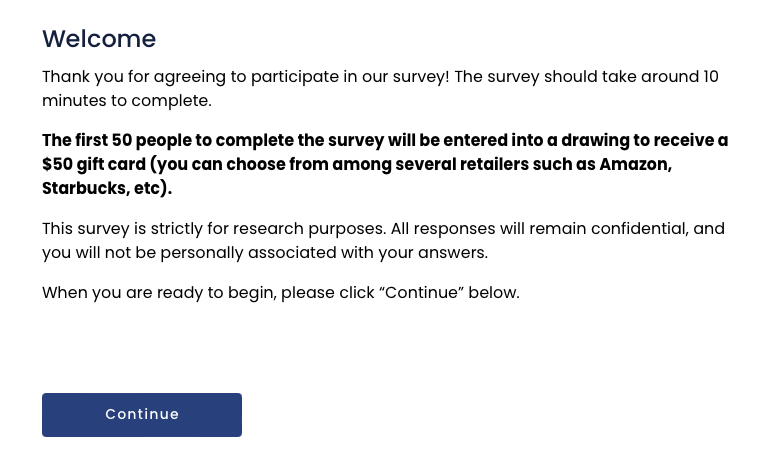
Be Transparent: Clearly communicate what the incentive is, how it can be earned, and any deadlines. Transparency builds trust and sets clear expectations. Mention the incentive up front in the survey invitation as well as at on the welcome page of the survey.
Ensure Value for Time: The incentive should be proportional to the length and complexity of the survey. A small discount or gift such as a free coffee at the museum café may be sufficient for a 2-minute survey, but a longer, more detailed survey will require a larger reward to encourage participation.
While incentives are powerful tools, it’s important to use them wisely to avoid unintended consequences. One of the biggest risks of offering incentives is that it can introduce response bias. Respondents who are motivated solely by the reward might rush through the survey without giving thoughtful or accurate answers. This can result in poor-quality data, as people may focus more on obtaining the incentive than on providing honest feedback. In some cases, participants may even provide false information just to complete the survey quickly.
Lastly, there may be legal or ethical concerns associated with offering certain types of incentives, especially if the survey is targeting vulnerable populations or if there are specific rules around prize giveaways. Depending on the nature of the survey and where the participants are located, you may need to ensure compliance with local laws regarding sweepstakes or tax reporting on incentives.
2. Survey Length
One of the main reasons people abandon surveys is length. A short, focused survey that can be completed quickly will have a higher response rate than a long, complex survey.
As tempting as it may be to ask every question you’ve ever wanted to know the answer to, it’s critical that you strip the survey down to only the essential questions. Each question should have a clear purpose and contribute directly to your research goals. Except for pricing studies and conjoint analyses, aim to keep your survey under 10 minutes. If you find you have more questions that can’t be covered within a 5- to 10-minute survey length, you may need to consider splitting the survey into two or three separate surveys.
Additionally, while open-ended questions can provide valuable qualitative insights, they require more time and effort from respondents. To keep your survey short and maintain engagement, use open-ended questions sparingly. You can reserve them for key areas where detailed feedback is essential and balance them with multiple-choice, ranking, or scale questions that are quicker to answer.
Finally, place the most critical questions first, as respondents are more likely to provide thoughtful answers at the beginning of the survey when they are most engaged. Less important or optional questions can be placed toward the end.
Pro tip: Let people know up front how long the survey will take to complete and use a progress bar or similar visual indicator to show respondents how far they’ve progressed through the survey and how much is left to complete.
3. Privacy
Keeping survey responses confidential is crucial for several reasons, ranging from protecting participants’ privacy to ensuring the quality and accuracy of the data collected. Confidentiality fosters trust between the survey creator and the respondent, encouraging honest, reliable responses.
People may hesitate to complete surveys if they feel their privacy is at risk. It’s important to make respondents feel comfortable by ensuring their responses will be kept confidential or anonymous.
Clearly communicate privacy: In your invitation and at the beginning of the survey, explicitly state how the data will be used and emphasize that personal information won’t be shared without consent. It’s often helpful to include language that the survey is strictly for research purposes and note that responses will not be personally associated with an individual’s answers. When people trust that their survey responses are handled confidentially, they are more likely to participate in future surveys from the same organization. This helps build long-term engagement and increases the likelihood of respondents providing valuable feedback in the future.
Use anonymous responses when possible: When respondents know that their answers will remain confidential, they are more likely to provide candid and truthful feedback. Confidentiality and anonymous responses help to minimize the fear of judgment, criticism, or negative consequences, which can otherwise lead to biased or inaccurate answers. For example, a member may feel safer offering constructive criticism about their experience if they know their responses won’t be traced back to them. Surveys often collect personal or sensitive data, such as demographics, health information related to accessibility, opinions on controversial issues, or financial status. When confidentiality and/or anonymity are guaranteed, respondents are more likely to answer thoughtfully and truthfully, knowing that their privacy is protected. This leads to higher-quality data that can be more effectively analyzed and used to make informed decisions.
Compliance with legal regulations: In many regions, there are legal requirements that govern the collection and handling of personal data, such as the General Data Protection Regulation (GDPR) in Europe. Keeping survey responses confidential helps ensure compliance with these regulations and protects both the survey creators and participants from legal ramifications. Failing to protect respondent confidentiality could result in violations of privacy laws and damage to the organization’s reputation.
Adhering to ethical research practices: In research, maintaining confidentiality is a fundamental ethical principle. Researchers are responsible for protecting participants’ privacy and ensuring that their data is used only for the intended purposes. Adhering to these ethical standards ensures that research is conducted responsibly, maintaining the integrity and credibility of the study.
Below is an example of a Welcome screen from our recently launched Lab on Community Goals and the Purposes of Membership which guarantees confidentiality for respondents.
By following these best practices, you’ll not only increase survey participation but also gather more meaningful and accurate insights that can drive better decisions.
Next week, I’ll share Part 3 of boosting survey response rates, including best practices on channels and methods.