
Many museums reduce strategy to a list of initiatives. While it’s often hard to prioritize initiatives, resource allocation is just planning, not strategy. Strategy is about making choices that are mutually self-reinforcing. Often, the resulting strategic priorities are at best unrelated, diluting impact, or, worse, they’re at odds with one another.
For example, a museum identifies several strategic priorities:
Activate museum collections
Build transformative partnerships
Create engaging personal experiences
What would need to be true to achieve these objectives?
For collections to be activated, curatorial vision and expertise would need to drive programming. For personal experiences to be engaging, programming would need to be rooted in a deep understanding of user outcomes and goals. How does that work if traditional expertise is in the driver’s seat? For partnerships to succeed, the museum needs to accommodate external objectives that may have little to do with any of the above. How can user experiences be truly personalized if the needs of partnering organizations are most important? It’s possible that these tensions can be resolved, but the strategy would need to clarify how (see: “even over” statements).
The answer isn’t to do more on top of existing practices. Instead, you can start from a different origin point. An organization wishlist model, which tends to generate incoherent and unintegrated activities, can be replaced by a user outcomes model that generates compounding results.
To illustrate what I mean by a user outcomes model, look at Roger Martin’s strategy choice cascade — Martin shares an example of a choice cascade from Olay, the skin care brand, in a new article on strategy and non-financial KPIs:
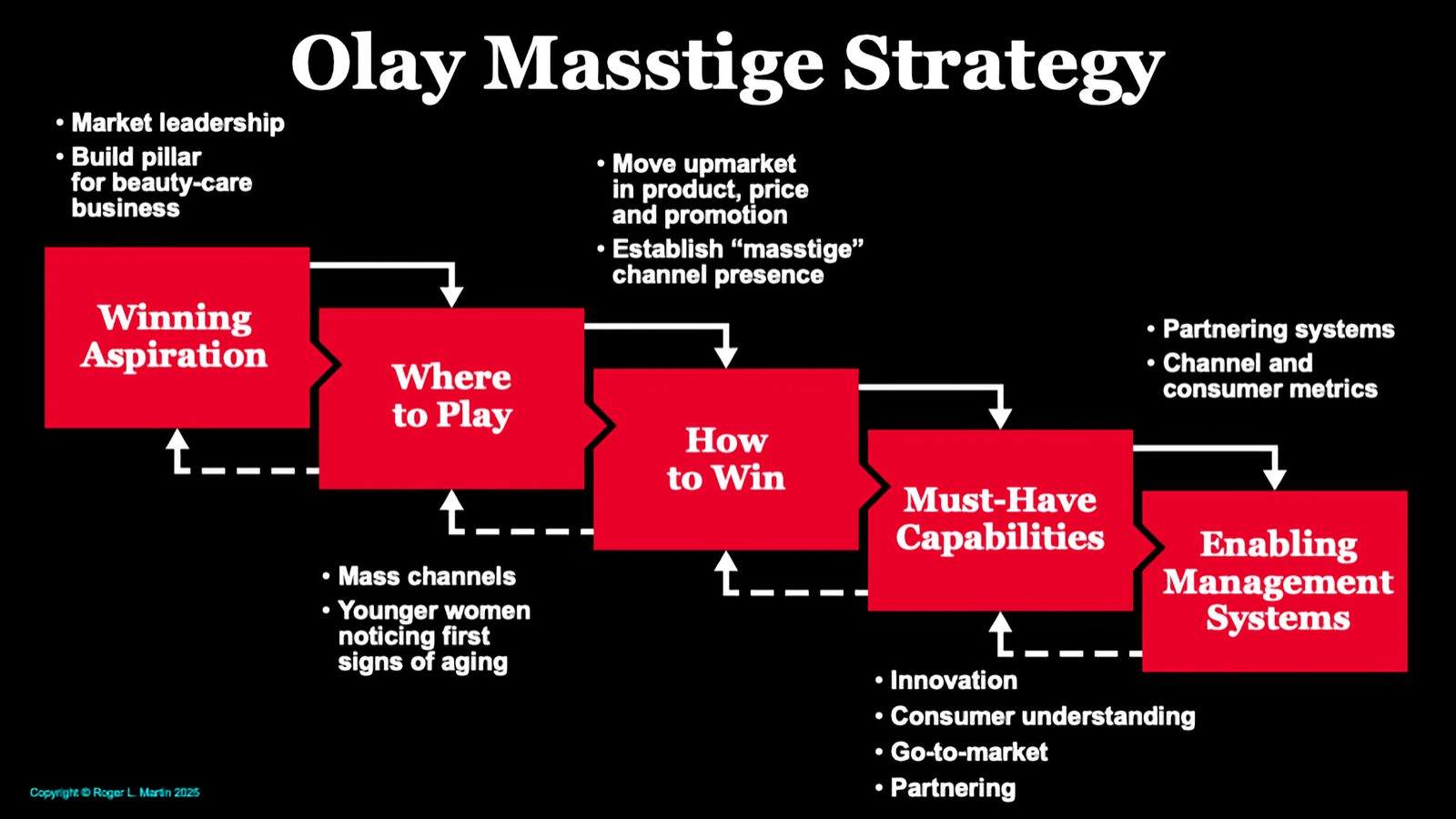
I won’t go into all the parts — let’s focus on the Where to Play part of the diagram, which specifies “Younger women noticing first signs of aging”.
At first glance, it seems like demographic segmentation (age, gender), but that’s not the real driver.
Keep in mind that for a long time, Olay had been thought by many to be a brand for “old people”; Their customer base was literally dying off (sound familiar?).
They did not approach the challenge by just saying, “let’s get younger people to buy our stuff”. They didn’t say, “let’s engage younger women,” or create an advisory board of younger women to somehow reveal insights into what all women their age think is cool.
Instead, they looked for behaviors indicative of a goal they could support. “Noticing the first signs of aging” is a moment in a person’s life that can and does influence their behavior. There’s emotion behind it — feeling anxious, seeking relief, regaining control, and a desire to feel appreciated or admired. These are human conditions, not organizational objectives. The space they chose was rooted in a quite specific goal with related outcomes.
You might be thinking, “Okay, but we’re not a skin care company competing for market share. We’re a museum.”
It doesn’t matter. Your institution still has to support people’s goals to be relevant to them.
In fact, you could argue that making integrated choices is even more important for museums, given resource scarcity and the many alternatives to museum participation that exist today. Besides, are we really going to believe that a skin care product, diaper company, or jar of peanut butter can have a strategy behind it, but a cultural institution can’t?
Can you sketch out your museum’s “where to play”? Just because you haven’t consciously decided on a territory doesn’t mean gravity isn’t already at work. You’re probably already talking about “engaging families” — what happens when that becomes “help my child succeed in school”? (Notice the shift in perspective from the museum as the first-person play to the individual’s point of view.) What changes when you go from “get more 20-somethings to visit the museum” to “find the perfect place for a date this weekend”? Or from “engage through personal experiences” to “make our trip to Seattle something we’ll never forget”?
Now I hear you saying: “But that’s so specific. We can’t create a five or ten-year plan around that.”
Setting aside the question of whether five and ten-year plans (which, again, are not strategies) are a good idea, it can be helpful to think in terms of outcome categories. These outcomes are the ones we use in MaP³ to help organizations identify where advantages lie, and they can be mutually reinforcing rather than competing or unrelated.
There is no inherent relationship between the goals of external partners and people who visit your museum. But it’s reasonable to think that a pair of social outcomes like “feel connected to something bigger than themselves” and “spend quality time with others beyond their own group or family” naturally support one another — working on one can generate results for the other, and vice versa. And within those two outcomes are many more specific goals that your museum could spend decades devising new ways to support.
What will your point of origin be for your next strategic plan — a wishlist that could belong to any museum or an integrated set of outcomes that leverage your unique strengths? What if a measure for success for your next strategic plan is that people from other museums read it and say, “That would never work here”? Because it shouldn’t. Because if it does, then your museum is interchangeable, not irreplaceable.